
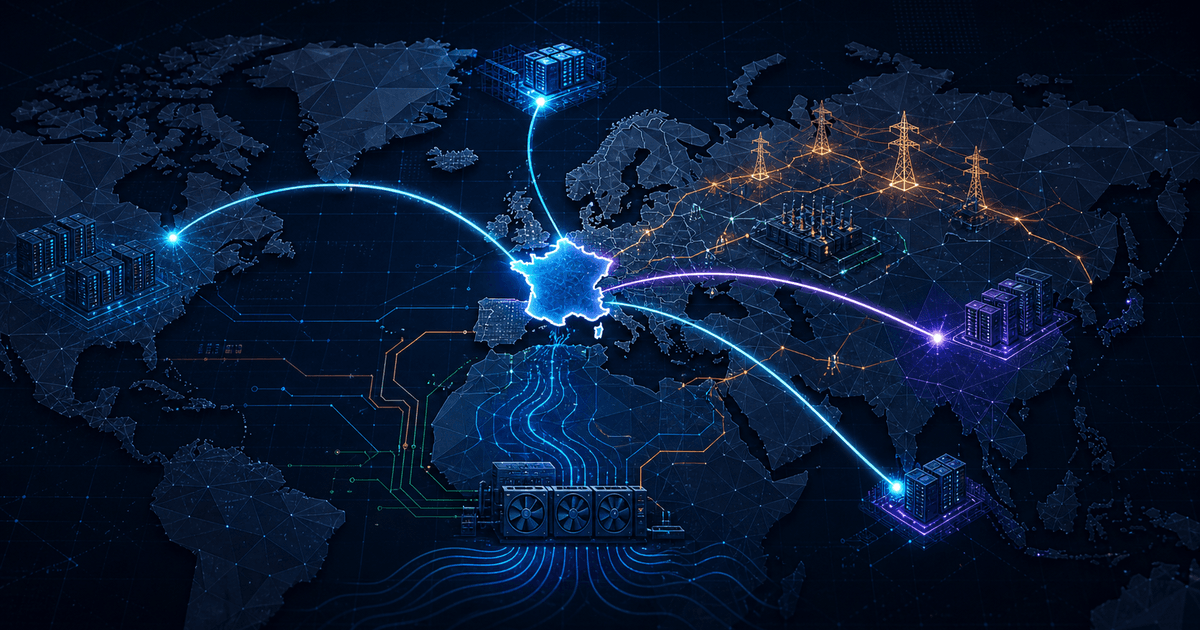
We talk a lot about model prices, GPUs, and AI subscriptions. We talk less about what makes all of it possible: data centers, power lines, cooling, land, permits, and grid connection delays.
For a French or European company adding AI to products, customer support, operations, or internal tools, this is no longer a background infrastructure detail. It is becoming a cost, sovereignty, and resilience question.
The question is no longer only: “Which model should we use?”
It is also: where does our AI run, with what energy, with which provider, in which cloud region, and with what dependency if prices or availability change?
AI is not immaterial: it depends on real data centers
For many teams, AI looks like an API. You plug in a model, add a summarization feature, automate a support response, or launch an internal agent. In the product interface, everything looks like software.
Behind each use case, however, there is a material chain: a model, GPUs, a cloud region, a data center, a substation, transmission lines, cooling, and energy contracts.
That chain is starting to matter. The U.S. Department of Energy says electricity demand from data centers in the United States could double or triple by 2028. The IEA also documents the issue globally: data center demand is now large enough to matter in energy scenarios.
This changes how we should look at AI. A feature that works well in a prototype can become expensive if 80% of customers use it every day. A support assistant running continuously does not consume like a boardroom demo. Image generation or agent chains can turn a product idea into a real compute-cost line.
Cloud makes the infrastructure feel abstract. The infrastructure remains physical.
The U.S. signal: when the grid becomes a bottleneck
In the United States, this reality is already visible. According to Engineering News-Record, the Federal Energy Regulatory Commission asked several major regional grid operators to justify or revise the rules governing connections for data centers and other very large electricity users.
Put simply: you do not connect a data center campus the way you open a SaaS account. You need studies, lines, substations, sometimes new generation capacity, and rules for who pays for upgrades.
That is the real U.S. signal. AI is no longer only a model race. It is becoming a race for grid access.
The examples are concrete. In Virginia, data center concentration is turning local electricity demand into a political and industrial issue. With Three Mile Island, Microsoft signed a long-term agreement with Constellation around restarting nuclear capacity for the grid. In Louisiana, Entergy describes the infrastructure needed to power Meta’s future data center.
One point from the earlier version remains important: this is not only about “more electricity.” It is also about flexibility. Can a data center reduce load when the grid is constrained? Can it move non-urgent workloads to off-peak hours? Who pays for lines, substations, and new capacity?
That is where grid-connection rules become strategic. If AI data centers can defer some training, batch processing, or non-urgent tasks, they do not affect the grid like a continuous priority load. If everything must run in real time, all the time, in one place, the constraint becomes much harder.
The point is not that every AI project will create an electricity crisis. The more precise point is that when compute becomes industrial, electricity, grid connection, flexibility, and location become strategic advantages.
A world tour: each region reveals a different constraint
The energy constraint does not appear the same way everywhere. That is what makes the topic interesting for Europe: copying the U.S. or China is not enough. Each territory has its own trade-offs.
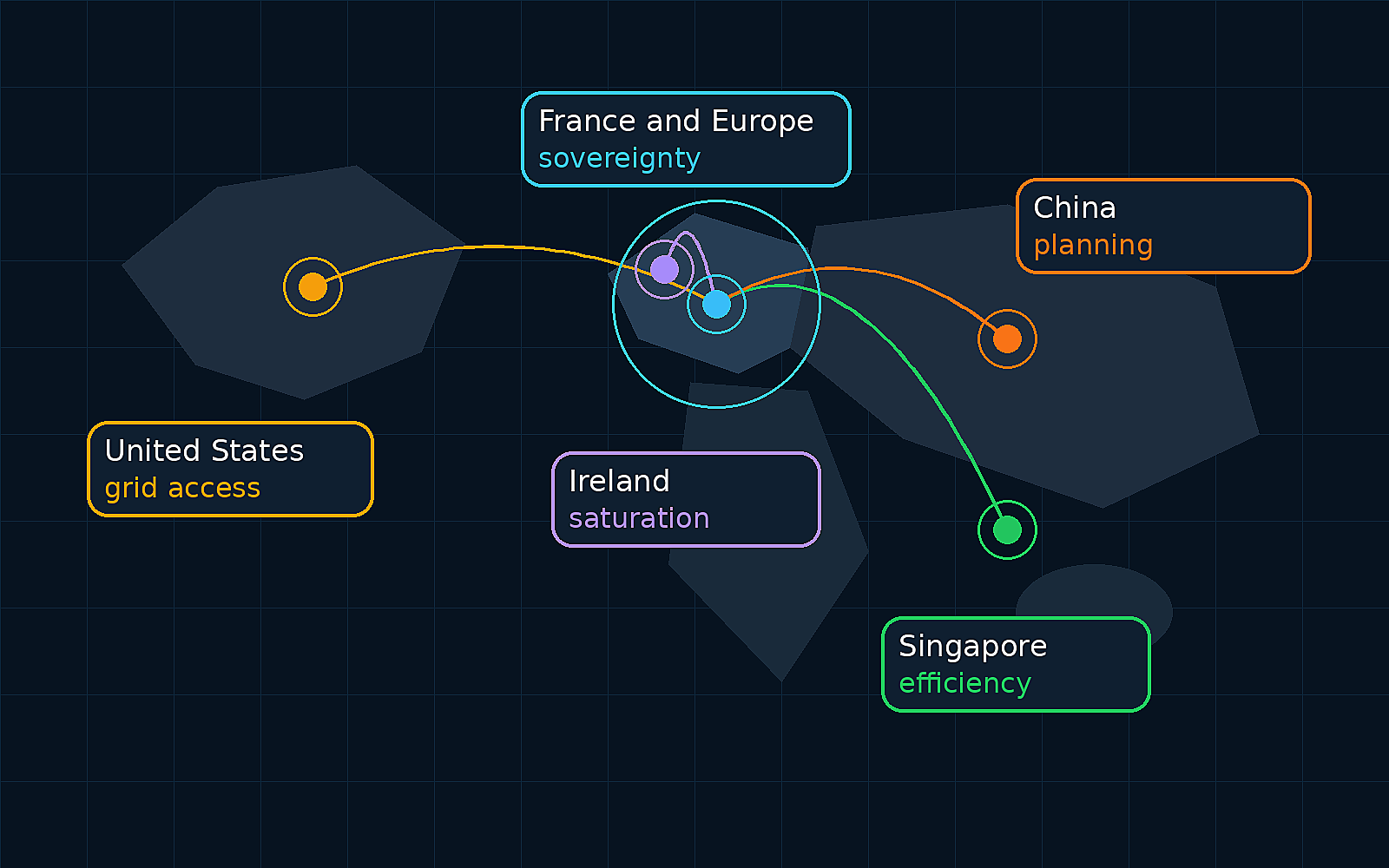
How to read this map: each zone illustrates a different constraint of physical AI.
- United States — connecting very large AI campuses quickly.
- Ireland — avoiding saturation in a small electricity system.
- Singapore — selecting projects through energy efficiency, land use and cooling.
- China — planning compute as national infrastructure and territorial development.
- France and Europe — thinking sovereignty, energy, cloud, models and data together.
United States: accelerating infrastructure
The United States has the hyperscalers, capital, GPUs, and large data center campuses. But this lead creates its own pressure: very large power users must be connected quickly without pushing all costs onto other grid customers.
That is the meaning of the FERC debate: how to accelerate the AI industry without turning every project into a local grid, transmission, generation, and acceptance problem?
Ireland: the European limit case
Ireland shows what happens when data centers become a massive share of national electricity use. According to Ireland’s Central Statistics Office, data centers consumed 6,969 GWh in 2024 and represented 22% of metered electricity use, up from 5% in 2015.
It is probably Europe’s clearest case. At some point, the question is not only: “Do we want to attract data centers?” It becomes: “What share of our electricity capacity do we want to allocate to them, and under what conditions?”
Singapore: selecting rather than accepting everything
Singapore illustrates another response. It is attractive for digital infrastructure, but constrained by land, power, and cooling. Its Green Data Centre Roadmap therefore frames growth through energy efficiency and access to cleaner power.
The logic is useful for Europe: the goal is not simply to attract more data centers, but to attract the right projects, in the right places, under the right constraints.
China: planning compute as national infrastructure
China approaches the topic with a more planned logic. Its “Eastern Data, Western Computing” strategy aims to move part of compute capacity toward regions where energy and land are more available, while keeping major economic centers in the east.
The point is not that this model can be copied in Europe. It cannot. But it shows one thing: compute location is becoming a territorial planning issue, not only a cloud architecture choice.
France and Europe: sovereignty, low-carbon power, and execution
This is where the topic becomes directly European.
The European Commission is pushing an “AI continent” ambition with AI Factories, AI Gigafactories, and more sovereign compute infrastructure. France highlights its assets in its plan to make the country an AI powerhouse: low-carbon electricity, high-voltage grid, sites able to host AI infrastructure, and simplified procedures.
That political framing matters because it moves AI from a software story to an industrial one: energy, land, data centers, skills, capital, cloud, and models.
That is a real potential advantage. But it is not magic.
Low-carbon electricity is not enough if grid connections take too long. “Ready” sites are not enough if local acceptance blocks projects. A sovereignty ambition is not enough if European companies still depend, in practice, on U.S. APIs for critical uses.
This is where Mistral AI matters. Mistral gives Europe a credible AI building block: proprietary models, open-weight models such as Mistral 7B and Mixtral, and distribution through its own platform and cloud partners. But a French company is not automatic sovereignty: the real answer depends on model choice, license, deployment mode, cloud region, logs, contract, and underlying provider.
For France and Europe, the question is not only how to build data centers. It is how to build a coherent AI capacity: energy, grid, cloud, models, data, cost, and sovereignty.
What this changes for a European company
Even if you do not build data centers, you already depend on this infrastructure.
A French scale-up adding an AI assistant to its SaaS product must choose between performance, cost, latency, and location. A company automating customer support needs to know what each ticket costs if usage becomes daily. A team processing sensitive documents needs to know where inference happens and which data leaves Europe.
The topic becomes very concrete:
- Where do our AI uses actually run?
- In which cloud region?
- With which provider?
- What is the cost per customer, ticket, document, or agent?
- What truly needs to run in real time?
- What can be batched, cached, or simplified?
- Which data can leave Europe? Which data cannot?
- What happens if a provider raises prices, limits access, or changes terms?
These questions are less spectacular than a model benchmark. They are closer to operational reality.
Model choice is central to that decision. If you use a proprietary frontier model — GPT, Claude, Gemini or equivalent — you often get top performance, but you depend on the provider that operates it and on the regions it offers. Some services provide European data residency or regional deployments, but teams must verify the exact deployment type: regional, global, cross-region, logs, support, subcontractors, retention, and contract.
Conversely, an open-weight model can be deployed with a chosen hosting provider, in a European region, or even in private infrastructure. That gives more control, but not for free: performance, security, operations, GPU cost, and answer quality must be managed. The real question is therefore: what level of control deserves what level of complexity?
In practice, this is no longer an abstract choice. At the time of publication, companies can look at model families such as Gemma 4, DeepSeek V3.1 or DeepSeek R1, MiniMax M3, or GLM-5.2. They do not serve the same needs, use the same licenses, carry the same inference costs, or create the same operational burden. But they make the discussion more concrete: should the company consume a turnkey frontier API, or accept more complexity in exchange for choosing the hosting location, technical stack, and data-processing rules?
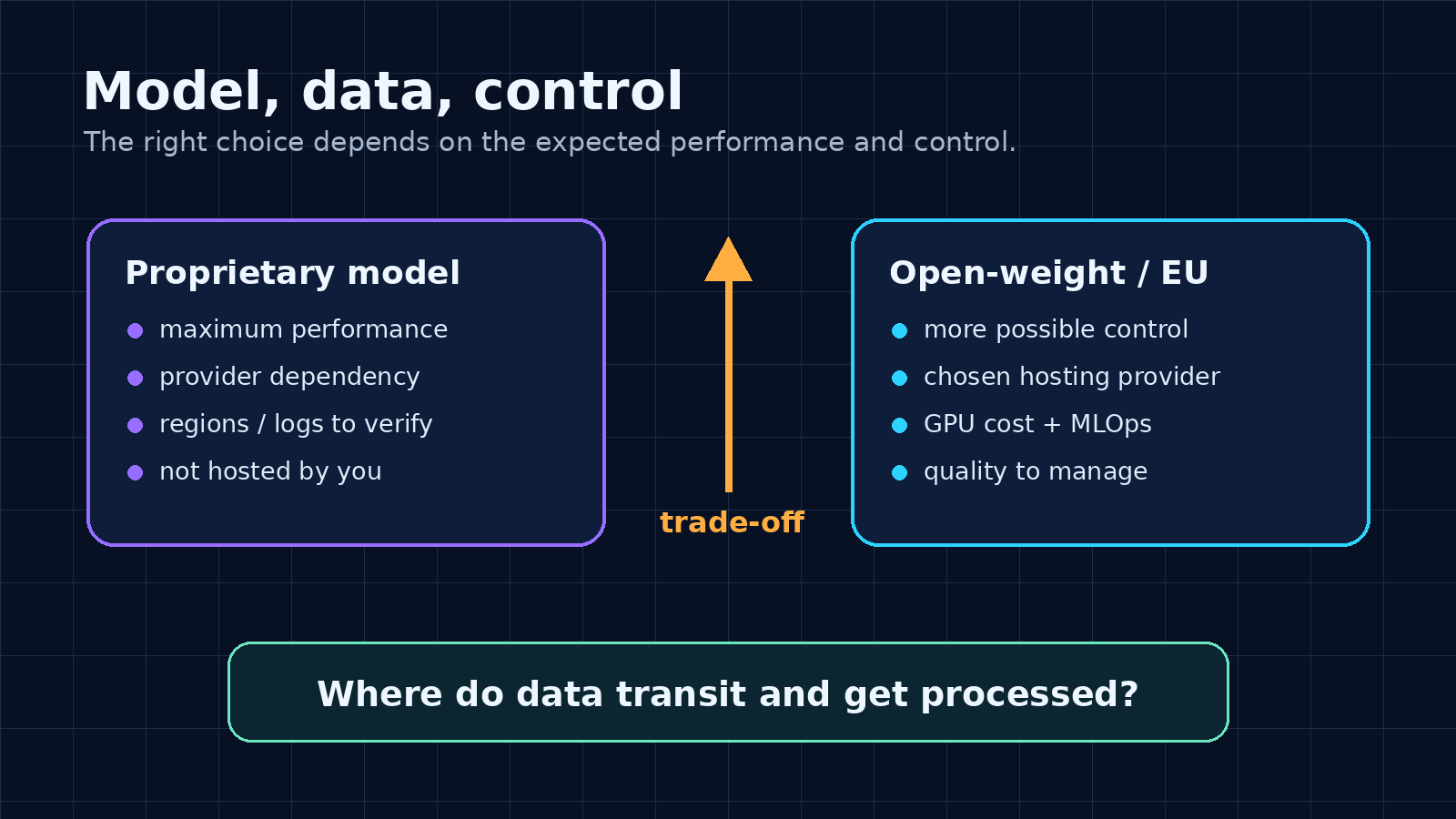
Choosing a model is not only choosing answer quality. It also means deciding where data transit and get processed, with what level of provider dependency, logging, contract protection, and control over European infrastructure.
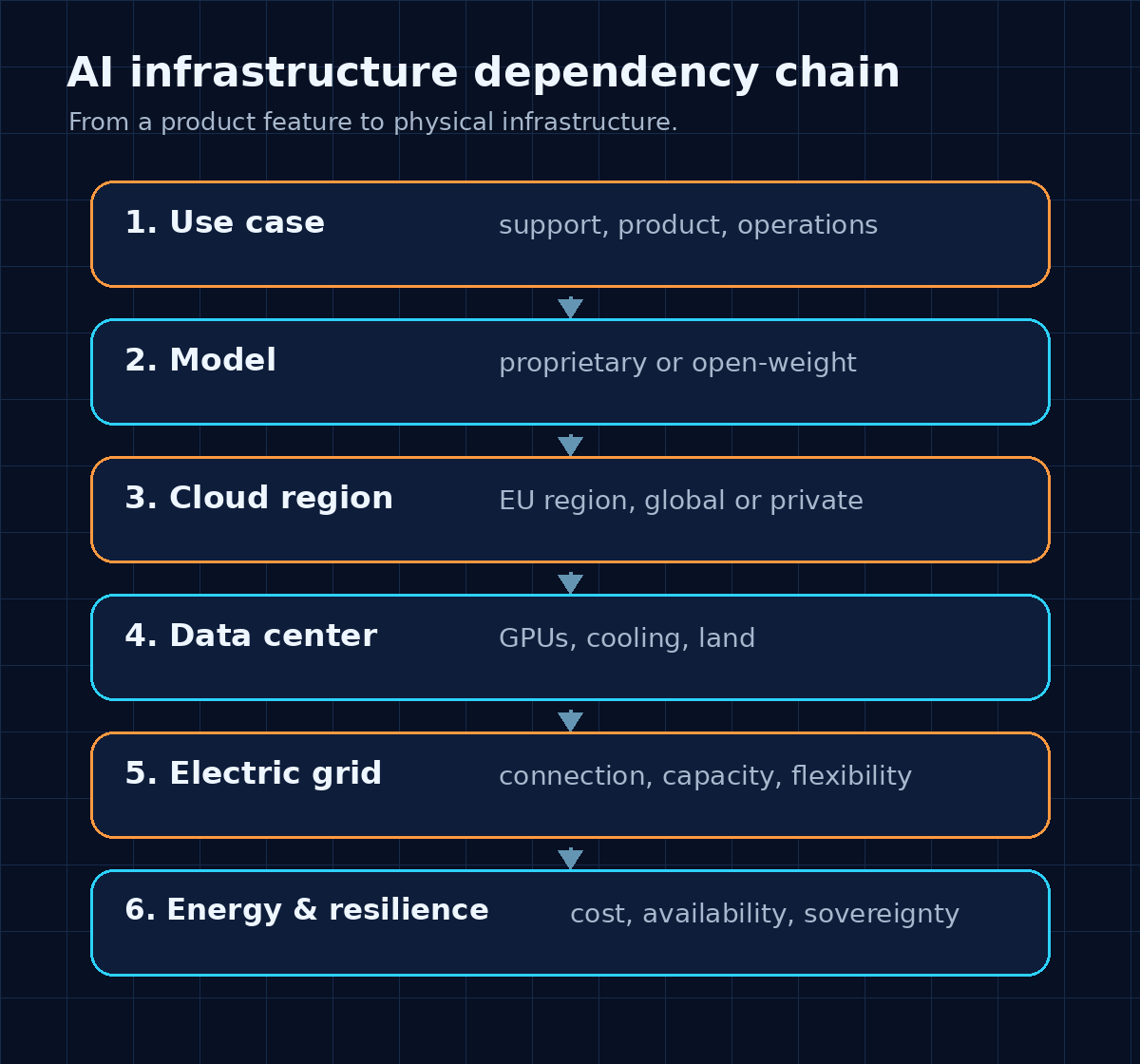
How to read the diagram: a software-looking AI feature commits the company to a full chain: business use case, model, hosting region, data center, electric grid, then energy and resilience. That link between compute, data centers, electricity, cooling, and sovereignty is what turns AI into an infrastructure dependency.
AI sobriety does not mean less AI
This does not mean companies should stop using AI. That would be absurd. The point is to learn how to use compute in the right place.
Not every task deserves the most powerful model. Not every answer must be generated in real time. Not every piece of data should go to the same API. Not every agent should call five models to produce an answer that a business rule, classic search, or smaller model could handle.
AI sobriety does not mean “less AI.” It means less wasted compute.
For European leaders, this becomes a practical decision grid:
- Location — where do models run and where do data stay?
- Full cost — what does real usage cost, beyond subscription pricing?
- Provider dependency — can we change model or cloud?
- Resilience — what is the degraded mode if AI becomes expensive, slow, or unavailable?
- Sovereignty — are critical use cases compatible with client and regulatory requirements?
- Efficiency — are we using the right model for the right task?
AI has to move from “nice product experiment” to a managed infrastructure dependency.
The new geography of AI
AI was first described as a model race. Then as a GPU race. It is now becoming an infrastructure race: energy, grid, location, sovereignty, and the ability to last.
That is an opportunity for France and Europe. Not because everything is already solved, but because the debate is shifting toward areas where Europe can have a card to play: low-carbon electricity, trust requirements, sovereign infrastructure, regulation, and execution quality.
But that requires looking at AI as a complete chain, not just a software interface.
The right question is no longer only: “Which AI will we use?”
It becomes: on what infrastructure do we want to build our dependence on AI?
Sources
- Department of Energy — DOE Releases New Report Evaluating Increase in Electricity Demand from Data Centers
- Lawrence Berkeley National Laboratory — 2024 United States Data Center Energy Usage Report
- International Energy Agency — Energy and AI
- Engineering News-Record — FERC Orders Grid Operators to Rework Data Center Power Rules
- Constellation — Crane Clean Energy Center / Microsoft agreement
- Entergy — Powering Meta’s data center in Richland Parish
- Central Statistics Office Ireland — Data Centres Metered Electricity Consumption 2024
- IMDA Singapore — Green Data Centre Roadmap
- European Commission — AI Factories
- Engineering — Review of China’s “East Data West Computing” strategy
- Élysée — Make France an AI powerhouse
- European Commission — AI Gigafactories
- Mistral AI — Mistral Large
- Mistral AI — Mistral 7B
- Mistral AI — Mixtral of experts
- Hugging Face — Google Gemma 4 31B IT model card
- Hugging Face — DeepSeek V3.1 model card
- Hugging Face — DeepSeek R1 0528 model card
- Hugging Face — MiniMax M3 model card
- Hugging Face — GLM-5.2 model card
- Microsoft Learn — Azure OpenAI / model deployment types
- AWS — Amazon Bedrock model support by region
- AWS — Cross-Region inference in Amazon Bedrock
Industrial and government sources are useful to understand announced strategies. They should be read as situated perspectives: a cloud provider, a state, or an energy company never describes the topic from a neutral position.