
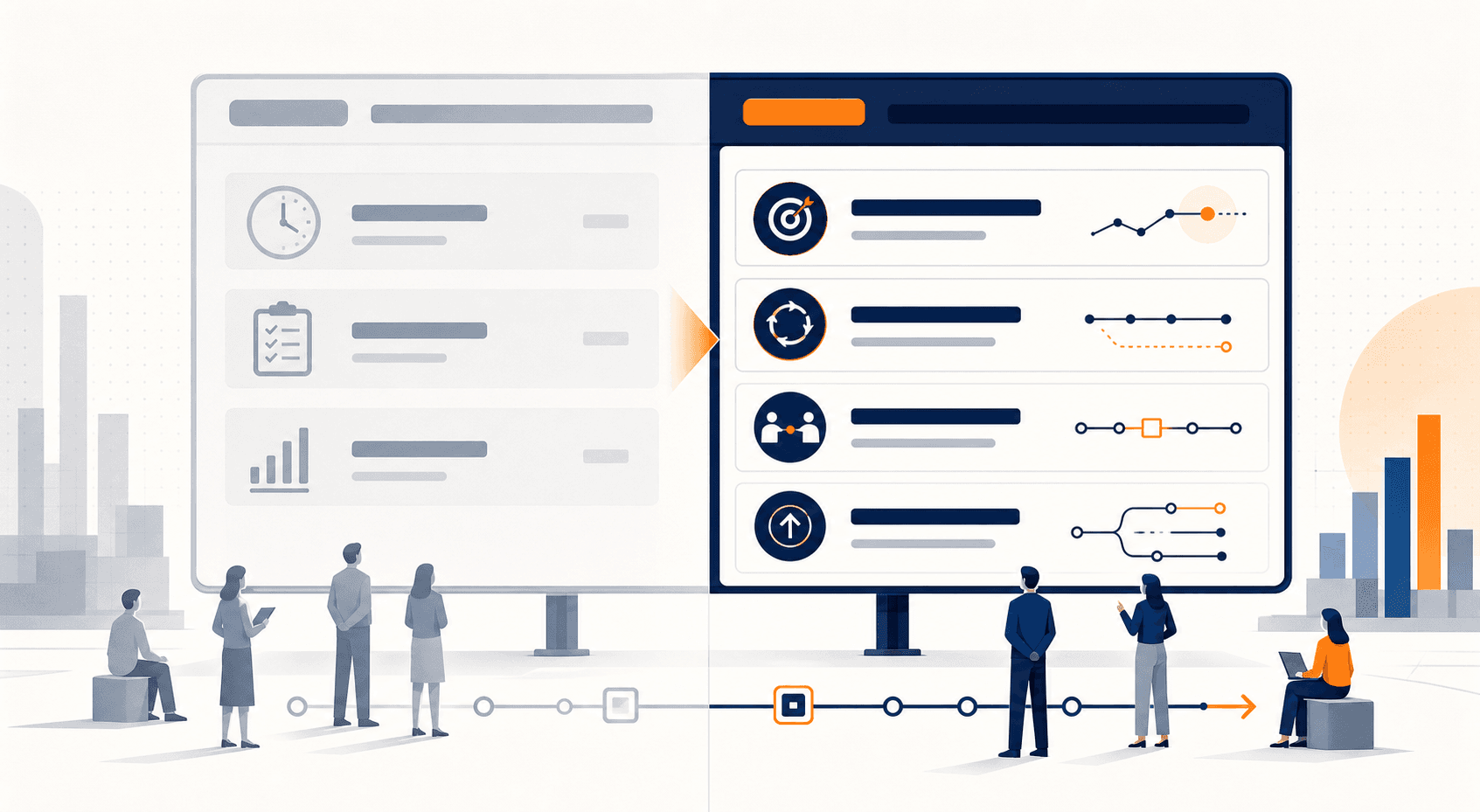
Many companies still start measuring AI with a stopwatch.
How many hours did we save? How many tasks did we automate? How many people use the tool each week?
These metrics are useful, but incomplete.
A MIT Sloan Management Review article illustrates this through a case observed in an administrative unit at the Community College of Philadelphia. The authors compared the same six-week period across four years, from 2023 to 2026. Staffing and hours worked stayed broadly stable. But the nature of the work changed.
In the case studied, coordination appears to move away from some meetings and toward more writing. There are fewer clarifications, cleaner first drafts, and decisions that stabilize faster.
For a company, the lesson is simple: if you only measure time saved, you may miss the real value.
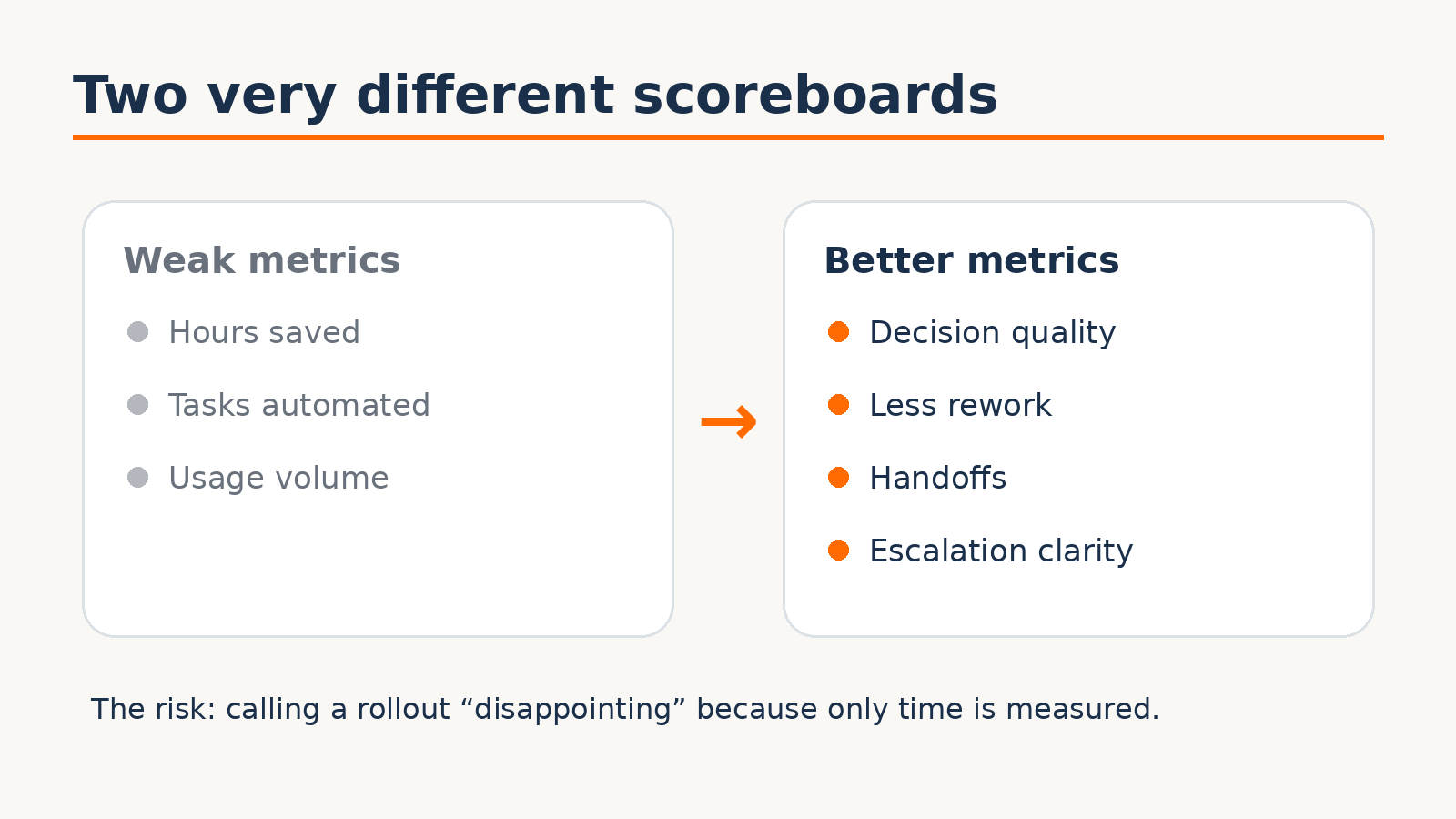
What time saved does not measure
Time is an attractive metric because it is simple. But many business processes are not isolated tasks. They move through decisions, approvals, exceptions, and handoffs.
In that context, AI can sometimes create more value by reducing rework, clarifying requests, or leaving usable information behind than by immediately removing hours of work.
The right question is not only: “how fast are people working?”
It becomes: “what kind of work are they producing?”
That matters for leaders. An AI project can be useful without immediately reducing hours worked. The value may appear elsewhere: fewer reworks, less ambiguity, better-prepared files, clearer decisions.
What this changes for B2B companies
In B2B, value often depends on information transfer: sales to Customer Success, support to product, operations to leadership.
AI is useful if it makes these transfers more reliable, not only faster.
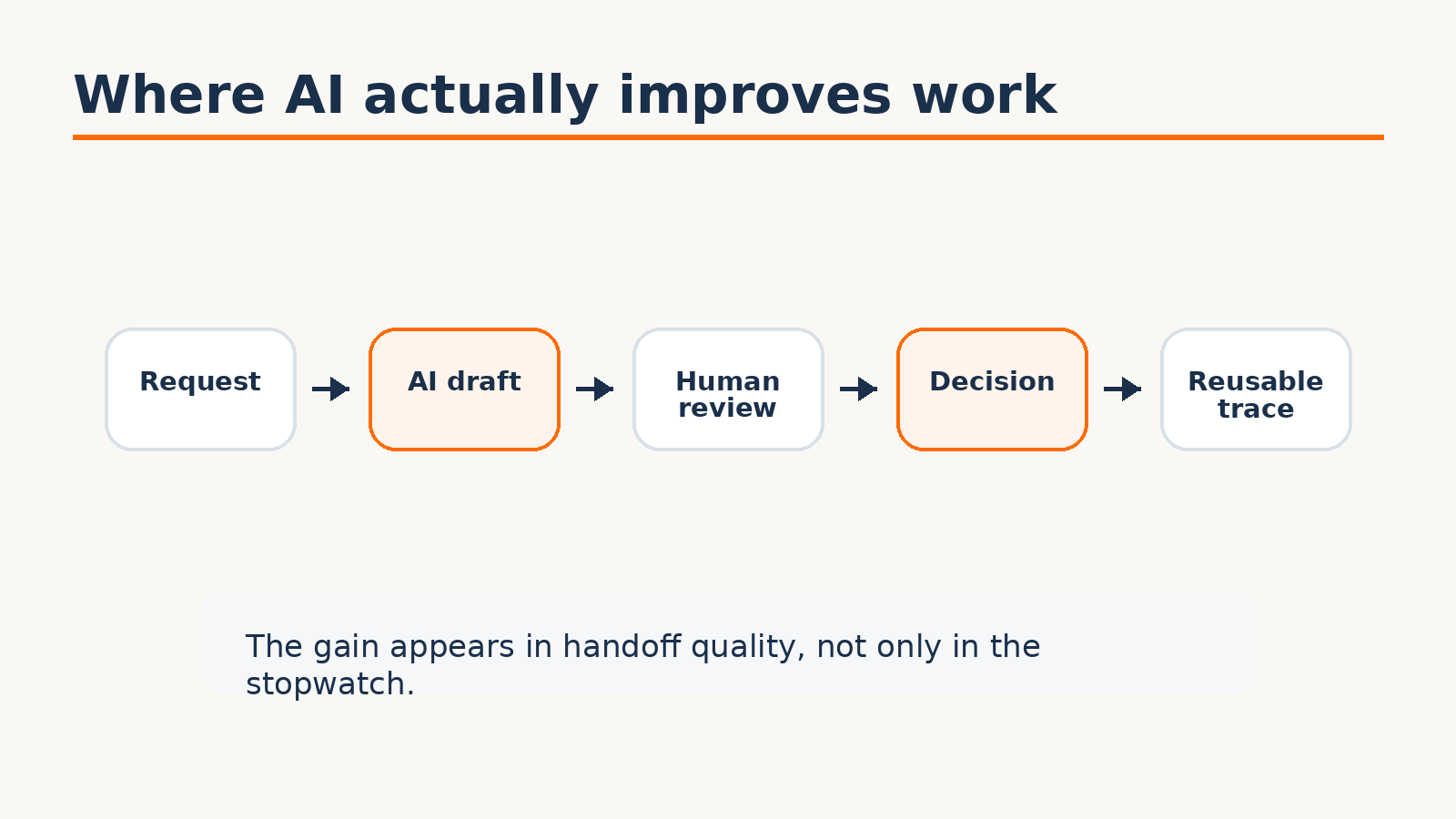
Example: a Customer Success team uses AI to summarize client calls. The real gain is not that the summary is produced in thirty seconds. It is that the summary is reliable, reviewed, stored in the right place, and still usable three months later.
The right question becomes: does the team decide better? Does it hand off information better? Does it revisit the same issues less often?
That is less spectacular than a massive productivity promise. But it is much closer to how work actually happens.
The right AI dashboard
A useful AI dashboard should of course track simple metrics: real usage, cost, time saved, automated tasks.
But it should also measure what AI changes in the business process:
- rework or corrections after an AI-generated result;
- time from request to usable decision;
- quality of handoffs between teams;
- cases escalated to the right level;
- reuse of the information produced.
These indicators are harder to collect. They require examples, qualitative reviews, and a real business discussion. But they measure more closely what AI can change inside an organization.
This logic becomes even more important with AI agents. The more AI acts inside a complete process, the less “writing time saved” is enough. Teams also need to measure how humans stay in control, how exceptions are handled, what traces are left, and whether people can take over when needed.
Choose the process before the tool
The first reflex is often to choose a tool.
The better reflex is to choose a process and define what “better” means.
Before deploying AI everywhere, a company can pick three important processes and ask simple questions:
- Where do we lose time clarifying the request?
- Where do decisions move backward too often?
- Where do handoffs create errors?
- Where is a trace missing when someone picks up the work?
- Where can AI help without deciding alone?
Only then should the company choose tools, review rules, and indicators.
This case does not prove a universal law. It concerns one specific administrative unit, while the other references mostly provide context. But it does show a common mistake: evaluating AI only through hours saved.
In some contexts, the most important gains may first appear in decision quality, reduced rework, clearer handoffs, and the ability to handle exceptions.
These are not secondary metrics. They can become the first serious metrics of mature AI adoption.
At GTL, this is exactly the kind of work we help clarify: starting from real processes, defining where AI should intervene, and building the rules that make its use reliable day to day.
Sources
- MIT Sloan Management Review — GenAI Success Metrics: Look Beyond Reduced Workload
- Marketing AI Institute — Two Things Every B2B Marketer Should Be Doing With AI Now
- One Useful Thing — The twilight of the chatbots