
The coding-agent market keeps drifting toward the wrong debate.
Everyone wants to know which model is smartest.
GitHub’s recent post about its experimental accessibility agent shows something else.
Useful agents do not replace organizational maturity. They make it executable.
That is what makes this case interesting: GitHub is not just showing a model that writes code. It is showing an operable system built on organizational memory, separated roles, guardrails, and a human escalation loop.
What GitHub actually built
In that post, GitHub says it is piloting an experimental general-purpose accessibility agent.
The agent has two main goals:
- provide reliable, just-in-time answers to accessibility questions in GitHub Copilot CLI and the Copilot VS Code integration
- catch and automatically remediate simple, objective accessibility issues
GitHub also says the system automatically evaluates changes that modify front-end code.
And GitHub gives a concrete operational result: in the post, the agent had reviewed 3,535 pull requests with a 68% resolution rate.
But that number is probably not the most interesting part.
The real value of the post is in how GitHub makes the agent possible, traceable, and deliberately constrained.
The real signal: useful agents amplify processes that were already mature
The GitHub post is saying something more precise than “workflow matters.”
GitHub explains that the agent works better because the company already had a mature system for logging and verifying accessibility issues: a structured reporting template, reproduction steps, severity metadata, service-area metadata, the applicable WCAG criterion, cross-links to the pull requests that addressed the issue, and acceptance criteria.
GitHub also says that this centralized corpus became ideal material for the agent.
In other words, the agent is not starting from zero.
It is standing on years of already-formalized human work.
Put differently: the more an organization has already turned its expertise into structured artifacts, the more leverage it gives to agentic automation.
That may be the most important lesson in the whole post.
The agent’s leverage comes from organizational maturity being made available to the system.
Architecture matters more than the demo
The post becomes even more interesting when GitHub describes the agent’s architecture.
The team says it started with a monolithic agent, then moved to a sub-agent architecture.
The architecture GitHub describes is organized around a parent agent and two specialized sub-agents:
- a passive reviewer / researcher
- an active implementer
Those sub-agents are sandboxed. They do not communicate directly with each other. Instead, they produce structured, templated output, which is then consumed by the parent agent that orchestrates, validates, and routes the next step.
That detail is more useful than a lot of abstract discourse about “agents.”
GitHub is not building one agent that does everything in a blur. It is separating roles, enforcing a form of traceability, and keeping an arbitration layer above the system.
That is much closer to an operable architecture than to a simple code-generation demo.
A good agent is not the one that always acts
The other especially strong part of the post is also the most counterintuitive one.
GitHub explains that a useful agent must sometimes not act.
To limit fragile fixes, the team uses a small script to evaluate code complexity. If the score passes a threshold, the agent does not execute code changes and instead directs the user toward the accessibility team.
GitHub also names high-risk patterns where the agent should avoid automatic remediation, including drag and drop, toasts, rich text editors, tree views, and data grids.
That is a crucial idea.
An agent’s maturity is not only visible in its ability to produce output. It is also visible in its ability to stop, escalate, and hand control back to a human when the risk gets too high.
That is what separates an impressive demo agent from one that is acceptable inside a real workflow.
The 68% resolution rate is a signal, not a definitive proof
The 68% resolution rate is interesting, but it should be read carefully.
The GitHub post does not give enough detail to treat it as a general proof of performance: we do not know the exact distribution of issue types, their severity, the false-positive rate, the time saved, or the remaining amount of human correction.
GitHub also notes that out of 55 WCAG level A and AA success criteria, only 35 can be detected through deterministic automated checkers.
So the number is useful as an operational signal inside a bounded scope, not as proof that an agent “solves accessibility.”
In fact, GitHub explicitly says in its conclusion that the agent is neither a turnkey solution nor a silver bullet.
What this says about the coding-agent market
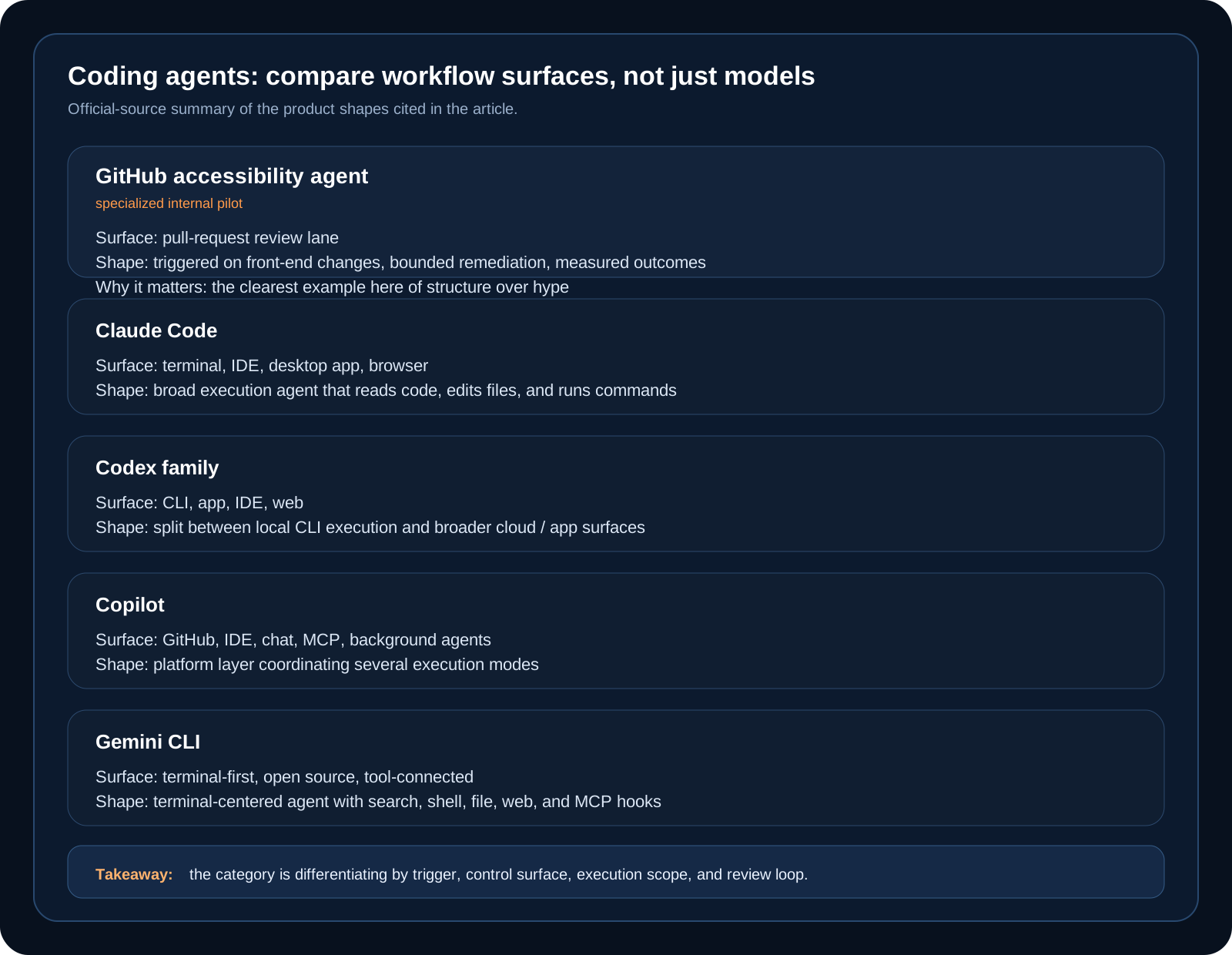
This reading also gives us a more useful way to look at the rest of the market. The question is not only where the agent lives, but what execution contract its surface imposes.
The market is not converging on one interface. Claude Code is spreading across several execution surfaces, including the terminal and IDEs. Codex exists across CLI, IDE, app, and web. Copilot is becoming a layer that shows up across GitHub, the IDE, the terminal, and delegation workflows.
On Google’s side, Gemini CLI illustrates the terminal surface. But Antigravity is more representative of the deeper move: an agentic platform that combines editor, terminal, browser, and a management surface for steering agents at a more task-oriented level.
The more autonomous these surfaces become, the more critical permissions, confirmations, logs, and escalation become.
But this fragmentation of surfaces does not change the core question. It makes it more important.
Whether the agent lives in a terminal, an IDE, GitHub, or an orchestration surface, we still need to know what it can see, what it can modify, when it should stop, how its work is reviewed, and when it should escalate.
That is exactly why the GitHub case is more interesting than a simple product panorama. It makes those requirements visible in concrete form.
The lesson for founders and engineering leaders
If I read this post as a product or engineering leader, I do not come away thinking GitHub has built “the best” agent.
I come away with something more useful.
Agents become credible when an organization turns domain knowledge into an operable system: structured data, separated roles, normalized outputs, guardrails, human escalation, and measurable review.
That is a more precise — and more useful — thesis than the simple claim that “workflow matters more than the model.”
The durable advantage probably is not raw autonomy.
It is operability.
Conclusion
GitHub’s accessibility agent does not “solve” either coding or accessibility.
And that is exactly why the post is interesting.
GitHub is showing an agent that does not replace a mature process. It amplifies one.
It relies on already-structured organizational memory. It separates roles. It keeps traces. It defines escalation paths. And in some cases, it knows not to act.
That may be the best current definition of a useful agent.
Not a system that promises general autonomy.
A system that knows how to become operable in the real world.
Verified sources
Verified on 2026-05-19.
Primary source
Supporting product sources
- Anthropic — Claude Code product page
- Anthropic docs — Claude Code overview
- OpenAI Codex CLI README
- OpenAI — Codex docs
- GitHub — Copilot feature page
- Google — Gemini CLI README
- Google Antigravity
The product comparisons in this article are interpretive. Attributed facts are limited to the sources above.