

The Meta/Instagram incident is worth studying precisely because it does not look like science fiction. According to the regulatory notice Meta filed with the Maine Attorney General, a vulnerability in an AI-assisted Instagram account recovery system was exploited to perform password resets.
The critical point is simple: the system could send a reset link to an email address that was not properly verified as already belonging to the targeted Instagram account.
In other words, the risk was not only that a chatbot could “answer badly.” The risk was that an AI interface was connected to a workflow with real authority over account access.
Main sources used for this article: Meta’s official notice via the Maine Attorney General, MIT Technology Review, the original 404 Media reporting, and this week in security. The regulatory notice is the center of gravity because it describes the failure mechanism and Meta’s remediation steps.
That is why this incident should be read as an operator signal. Most companies are not deploying advanced autonomous cyber agents. But many are already connecting AI to support queues, internal help desks, onboarding, refunds, account recovery, and HR workflows. These are exactly the zones where identity, permissions, trust, and automation meet.
What the Meta/Maine AG notice describes concretely
The official regulatory notice gives the most concrete explanation.
In a breach notice filed with the Maine Attorney General, Meta says it discovered on May 31, 2026 that a vulnerability in an AI-assisted Instagram account recovery system — called “High Touch Support” or “HTS” — had been exploited to perform password resets on Instagram accounts.
Meta’s explanation is important because it separates the conversational support tool from the underlying control failure. The notice says HTS was designed to help locked-out Instagram users regain access and could send a password reset link to a user’s email address. The tool itself “worked properly and functioned as intended,” Meta says, but a separate code path did not properly verify that the email address provided by the person requesting the reset matched the email address already associated with the Instagram account.
That is the concrete failure pattern: when someone gave an email address that was not already associated with the account, the system incorrectly sent a password reset link to that unrelated email instead of rejecting the request.
AI therefore enters the picture at the level of the HTS support and recovery workflow: it is not described as having “hacked” the account, but as part of a path that could trigger a sensitive action — sending a password reset link.
The scenario can be read as a classic application-control chain:
- someone starts an Instagram account recovery request;
- the HTS workflow collects or receives an email address to use for recovery;
- that email address should have been checked against the email already associated with the account;
- in a separate code path, that check did not work properly;
- the system could therefore send a reset link to an email address not associated with the account;
- the person controlling that email address could use the link to change the password;
- if no effective second factor blocked the login, unauthorized access became possible.
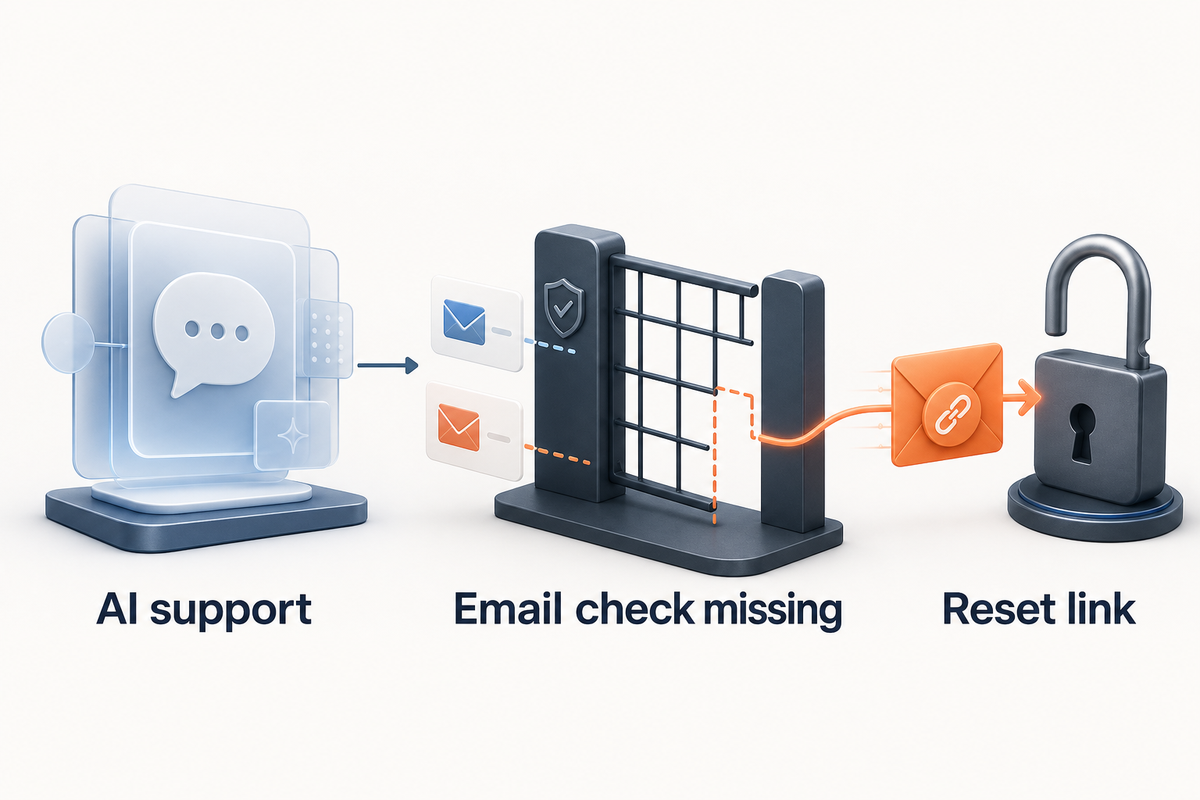
The AI link is the HTS/support workflow: it receives the recovery request and can trigger a sensitive action. The flaw is the missing email check before the reset link is sent.
Seen that way, the failure was not “AI hacked an account” or “the model decided to grant access.” It was an identity-control failure inside an AI-assisted workflow: HTS could help trigger a sensitive action, but a separate code path did not correctly verify that the provided email matched the email already associated with the account.
According to this summary of the notice, a follow-up from this week in security says Meta notified at least 20,225 people overall, including 30 people in Maine, and quotes the same notice language about a vulnerability in an AI-assisted account recovery system for Instagram. The same report says the potentially accessible data included account profile information, contact details, posts, direct messages, account activity, and linked accounts.
In other words, the dangerous part was not the chatbot conversation by itself. It was the fact that the conversation was connected to a recovery workflow with authority to change account access.
What Meta officially communicated
There are two different levels of “official” communication here.
First, there is an official regulatory communication. The Maine Attorney General data breach page lists Meta Platforms, Inc. as the reporting entity, names Meta Associate General Counsel Amber Hannah as the submitter, and links to Meta’s notification letter. The page reports 20,225 affected people overall, 30 Maine residents, April 17, 2026 as the breach date, May 31, 2026 as the discovery date, and June 19, 2026 as the consumer notification date.
Second, there is public comment, but the accessible source set does not include a detailed public postmortem from Meta. MIT Technology Review says Meta did not respond to its request for comment, but that a Meta spokesperson said on X the vulnerability had been resolved.
The official notice also describes Meta’s remediation steps: disabling the AI-assisted support tool to remove the vulnerable code path from production, invalidating reset links generated through that path, forcing potentially affected accounts through a security checkpoint, instructing impacted users to reset passwords, and reviewing similar recovery flows before relaunching the tool.
That last point is the broader signal. The notice suggests Meta did not treat the incident only as a one-off patch: it also says Meta is reviewing similar account recovery flows across its platforms. That is exactly the kind of workflow-level review most companies need before they connect AI to sensitive actions.
The lesson is not “do not use AI in support”
That would be too easy, and probably wrong.
Support and ops automation can reduce cost, increase speed, and remove painful manual loops. The lesson is narrower and more useful: do not confuse conversational flexibility with safe authority.
Classic software systems are brittle in obvious ways. They do what they were coded to do, and the failure often lives in a permission, validation, or business-logic bug. AI agents introduce a different surface. They are designed to interpret requests, satisfy intent, and complete tasks across messy language.
That is useful when a customer needs help. It is dangerous when the agent can also trigger identity changes, password resets, refunds, access grants, or escalation bypasses.
The risk is not only model quality. It is workflow design.
The authority map to review before rollout
Before adding AI to a sensitive process, teams should be able to answer five questions:
- What authority does the system actually have?
- Which actions are reversible?
- Which actions require a second factor or human approval?
- What evidence is logged when the system makes a decision?
- What happens when a user deliberately asks the system to violate the intended process?
Those questions are boring. That is why they matter.
The next wave of AI failures will not all look like spectacular demonstrations from a lab. Some will look like ordinary product shortcuts: an account recovery flow optimized for convenience, a support assistant allowed to “resolve” too much, a permission change hidden behind a friendly chat interface, or a fallback path that was never red-teamed because it looked like back-office plumbing.
For founders and product teams, this changes the deployment conversation. The right question is not only “Can the AI answer correctly?” It is “What can the AI do when it is wrong, manipulated, or overconfident?”
For buyers, it changes the vendor conversation. If a tool promises AI-powered support, identity, or operations automation, ask where the authority boundaries are. Ask which actions are gated. Ask what gets logged. Ask how the system handles adversarial requests, not just unhappy customers.
For security teams, it is a chance to make AI governance practical. Instead of debating abstract model danger, start with an inventory of AI-assisted workflows that touch money, identity, access, private data, or reputation. Then classify them by blast radius.
A low-risk assistant can summarize tickets. A high-risk assistant should not unilaterally reset ownership of an account.
GTL take: map automation before it becomes authority
AI adoption needs an authority map, not just a prompt review.
A practical review should produce five artifacts:
- an inventory of AI-assisted workflows;
- an authority map showing where the system can read, decide, write, and escalate;
- a list of irreversible or high-impact actions;
- the required gates, such as second factor, human approval, policy checks, rate limits, rollback, and audit logs;
- a red-team scenario list for adversarial users, not only normal customers.
This is where AI governance becomes concrete. Not a policy document first. A workflow-level control map.
The companies that deploy AI well will not be the ones that avoid automation. They will be the ones that know which parts of the workflow can be automated safely, which parts need hard gates, and which parts should remain deliberately slow.
In other words: the future of AI security may be less about stopping mythical agent breakouts and more about auditing the ordinary workflows we are already giving agents permission to touch.
Sources
- Meta Platforms / Maine Attorney General — Data Breach Notice page and notification letter
- MIT Technology Review — The Meta hack shows there’s more to AI security than Mythos
- this week in security — Meta confirms thousands of Instagram accounts were hacked by abusing its AI chatbot
- 404 Media — Hackers Simply Asked Meta AI to Give Them Access to High-Profile Instagram Accounts. It Worked.