
SaaStr is one of the best-known B2B SaaS media and event brands, with a strong founder, operator, and go-to-market audience. That is what makes its internal AI traffic data interesting to read — even if it is not market-wide proof.
The mistake is to read SaaStr’s spike as proof that every AI content strategy works. The better reading is that trusted B2B brands can still capture attention when they turn noisy AI demand into useful interpretation.
That is why this source matters.
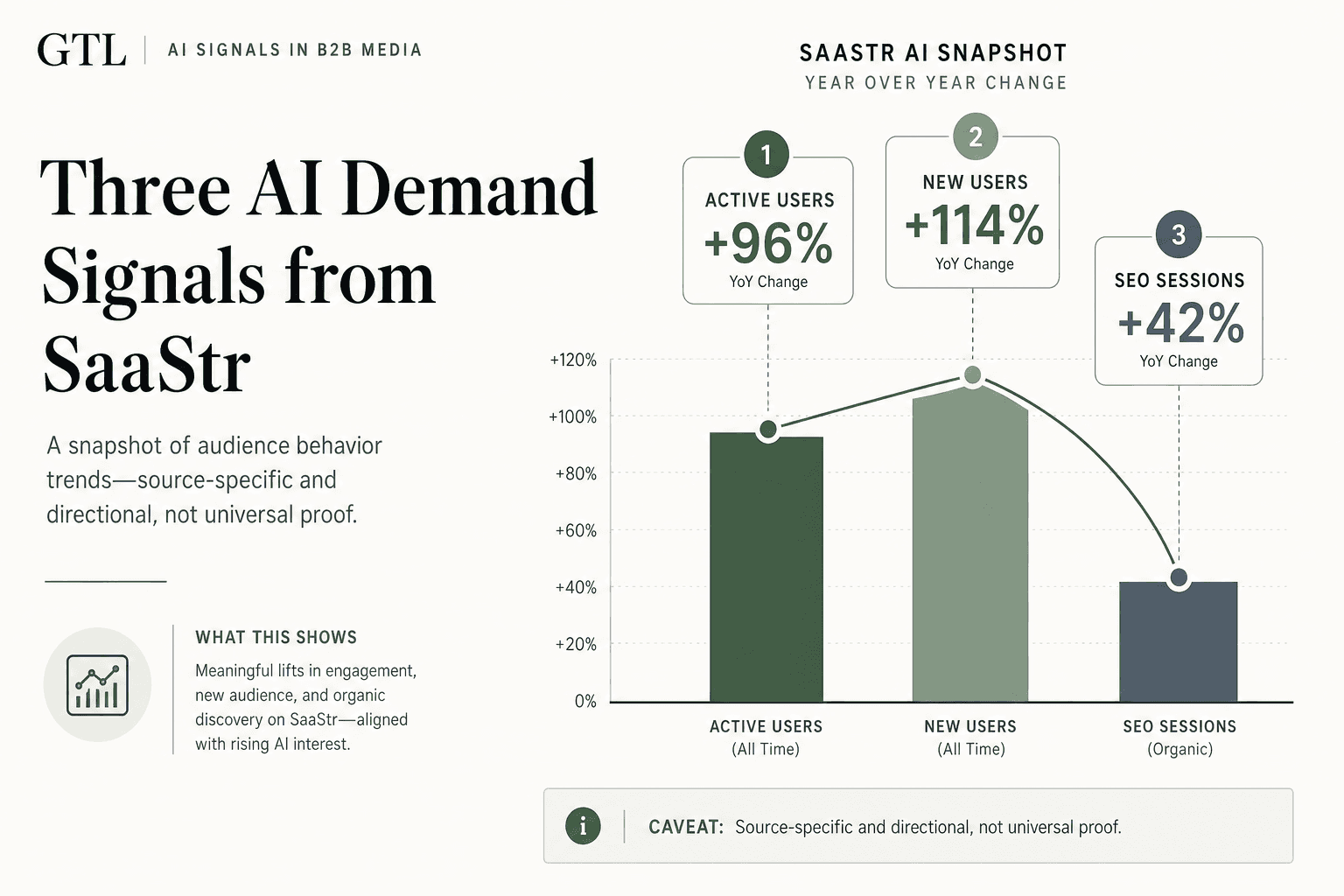
SaaStr’s published 28-day year-over-year snapshot across SaaStr.com and SaaStr.ai reports:
- active users: +96%
- new users: +114%
- organic search users: +42%
- referral users: +116%
Those figures come from SaaStr’s own published GA4 snapshot, not from an independent market benchmark.
What the source actually proves
The source proves one thing quite clearly: for one highly visible B2B media property, AI interest is still strong enough to lift several acquisition channels at the same time.
That matters because it suggests two things.
First, AI attention is still available. Second, search is not automatically dead for AI content just because the market is saturated with launches and commentary.
What the source does not prove is that every AI company, every SaaS category, or every B2B publisher will see the same pattern.
SaaStr itself is explicit about the scope: this is a view into its own properties and its own analytics setup. The chart also notes that paid social is omitted because of a near-zero baseline and unassigned traffic is excluded.
The mistake would be to read this as a market benchmark. The opportunity is to read it as a distribution lesson.
Why interpretation is becoming the real edge
This is where the article becomes more useful than the headline.
The interesting signal is not simply that “AI content works.” It is that trusted distribution still compounds when the content helps readers do something with a noisy market.
Attention is still available, but generic AI commentary is not the moat.
The real edge is the translation layer.
Founders, operators, and buyers do not just need another launch summary. They need someone to translate a signal into:
- what changed
- who it affects
- what it means for cost, rollout, workflow, or team design
- what decision should change because of it
For a B2B team, that changes the content job. The goal is not to cover every AI announcement. The goal is to help a buyer decide whether a signal changes their roadmap, their budget, their hiring plan, or their operating model. A launch summary tells people what happened. A useful editorial layer tells them what to do with it.
What B2B teams should do with this signal
For founders and CEOs
Do not read this as proof that “doing AI content” works by default. Read it as a signal that a credible brand can still earn attention when it pairs topical demand with a clear point of view and operator usefulness.
For CMOs and growth teams
Do not reduce the lesson to SEO alone. The stronger reading is that authority, search, newsletter, referrals, and editorial clarity reinforce each other when a brand already knows how to interpret a market for its audience.
For product and ops leaders
Treat signals like this as prompts for better filtering. The question is not whether every AI launch deserves coverage. The question is which signals actually change adoption, workflow, budget, or team design enough to deserve a serious response.
What remains uncertain
This source still has clear limits.
We do not know how representative SaaStr’s audience mix is versus the broader B2B market. We do not know how much of the direct traffic increase reflects stronger brand pull versus attribution noise. And we do not know how durable this spike is beyond the measured window.
So the right conclusion is not hype.
It is simpler than that: trusted B2B brands still have room to capture attention when they turn AI demand into useful interpretation.
That is already a meaningful signal.
Sources
- SaaStr — AI Is On Fire. And So Every Single B2B Traffic Channel Is Up YoY for SaaStr AI. Even SEO is Up +42%
- SaaStr published chart image — GA4 snapshot