
A lot of AI strategy still sounds like a tooling conversation.
Which model should we use? Which assistant should we buy? Which workflow should we automate first?
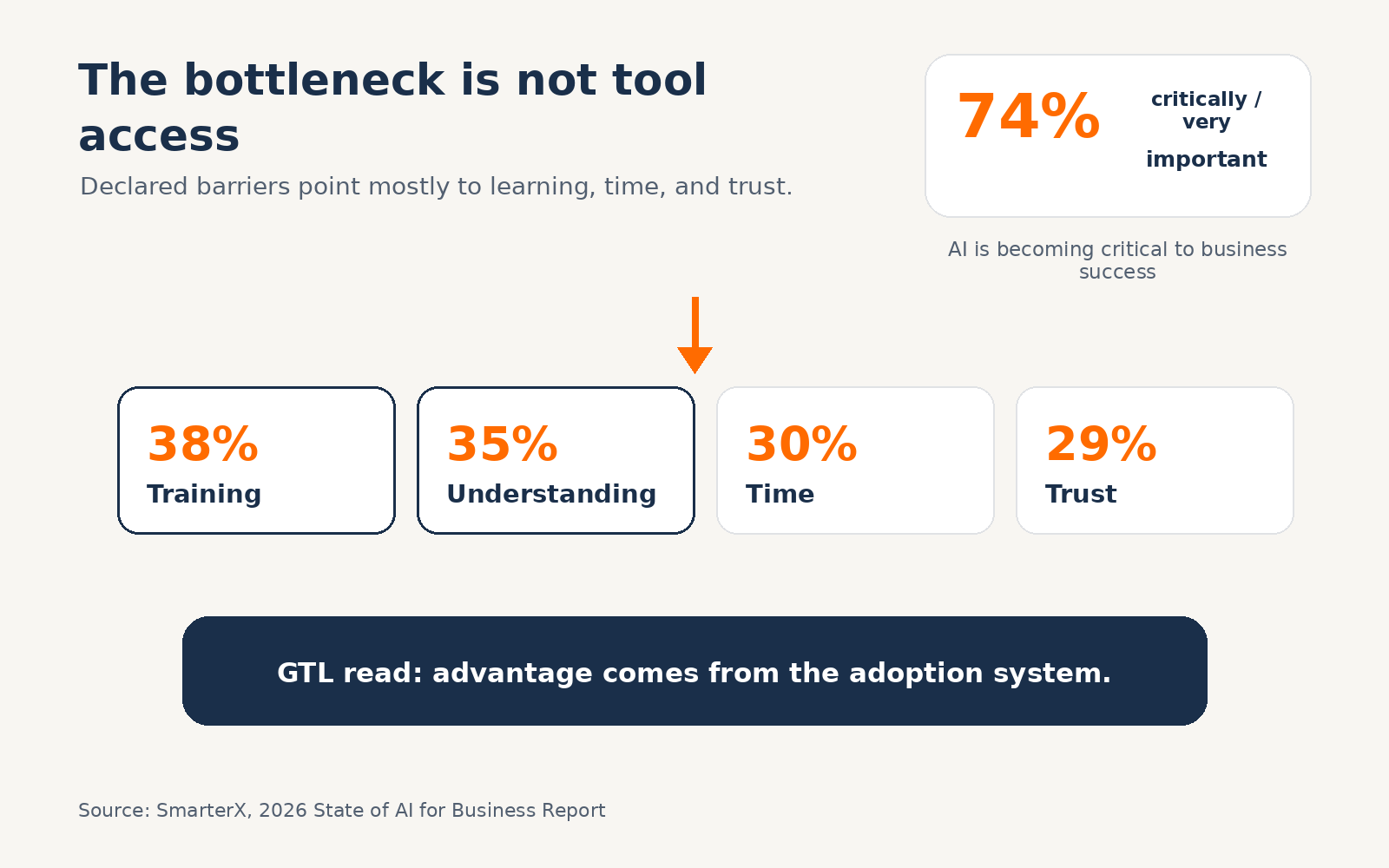
Those questions matter. But the more interesting signal in the SmarterX 2026 State of AI for Business Report is that the bottleneck may already be shifting. SmarterX says it surveyed more than 2,100 professionals across functions, industries, and company sizes. In that sample, 74% of respondents say AI is critically or very important to business success in the next 12 months. Among CEOs and founders, that number rises to 89%.
So the pressure to adopt is no longer subtle.
But the top barriers people report are not “we cannot access the right model.” They are lack of education and training, lack of awareness or understanding, lack of time, and fear or mistrust of AI.
That changes the operating picture.
What the source actually shows
The strongest claims should stay close to the source.
SmarterX reports that:
- 74% of respondents see AI as critically or very important to business success in the next 12 months.
- 89% of CEOs and founders say the same.
- 71% believe AI will eliminate more jobs than it creates, while only 20% express concern about their own role.
- The top reported adoption barriers include lack of education and training (38%), lack of awareness or understanding (35%), lack of time (30%), and fear or mistrust of AI (29%).
Marketing AI Institute’s B2B analysis adds useful context: it says 84% of the surveyed professionals work fully or partially in B2B organizations, and about a third are marketers. Its follow-up coverage also highlights a practical point that matters for operators: the issue is not only whether people understand AI in theory, but whether they have time to learn it, integrate it into workflows, and trust it enough to change how work actually gets done.
That does not prove a universal market law. Survey research captures declared beliefs and barriers, not measured productivity outcomes.
But it does give B2B leaders a useful signal: in many teams, the adoption constraint is becoming human and organizational before it is purely technical.
The “people, not tools” reading
The simple version is tempting: companies already have tools, but people are the problem.
That would be too crude.
The better reading is this: AI tools are becoming easier to access than the organizational conditions required to use them well.
You can buy a model subscription in minutes. You can connect a meeting assistant, a research tool, a coding agent, or a content workflow with a credit card. But that does not automatically answer the harder questions:
- Which tasks should move from manual execution to AI-assisted execution?
- Who is accountable when the output is wrong?
- Which workflows should change, and which should stay deliberately human?
- How do managers create time for experimentation without turning work into permanent side projects?
- How do teams build enough trust to use AI without pretending risk disappeared?
That is why “AI adoption” often becomes change management in disguise.
A simple example: customer follow-up
Take a Customer Success team. AI can already summarize a client call, suggest next steps, and draft the follow-up email.
But the value does not come only from the generated text. It depends mostly on the work around it: who reviews before sending, where the summary is stored, and how the person in charge of the account finds that information three months later.
Without those simple rules, the tool produces content that is useful in the moment, but not very reusable afterwards. The problem is not the tool. It is how the team integrates it into daily work.
The operating model matters more than the tool list
A B2B team that only asks “which tool should we deploy?” will usually get a shallow answer.
The more useful question is: how does AI concretely enter our work: on which tasks, with which rules, and with what human accountability?
That system has several layers.
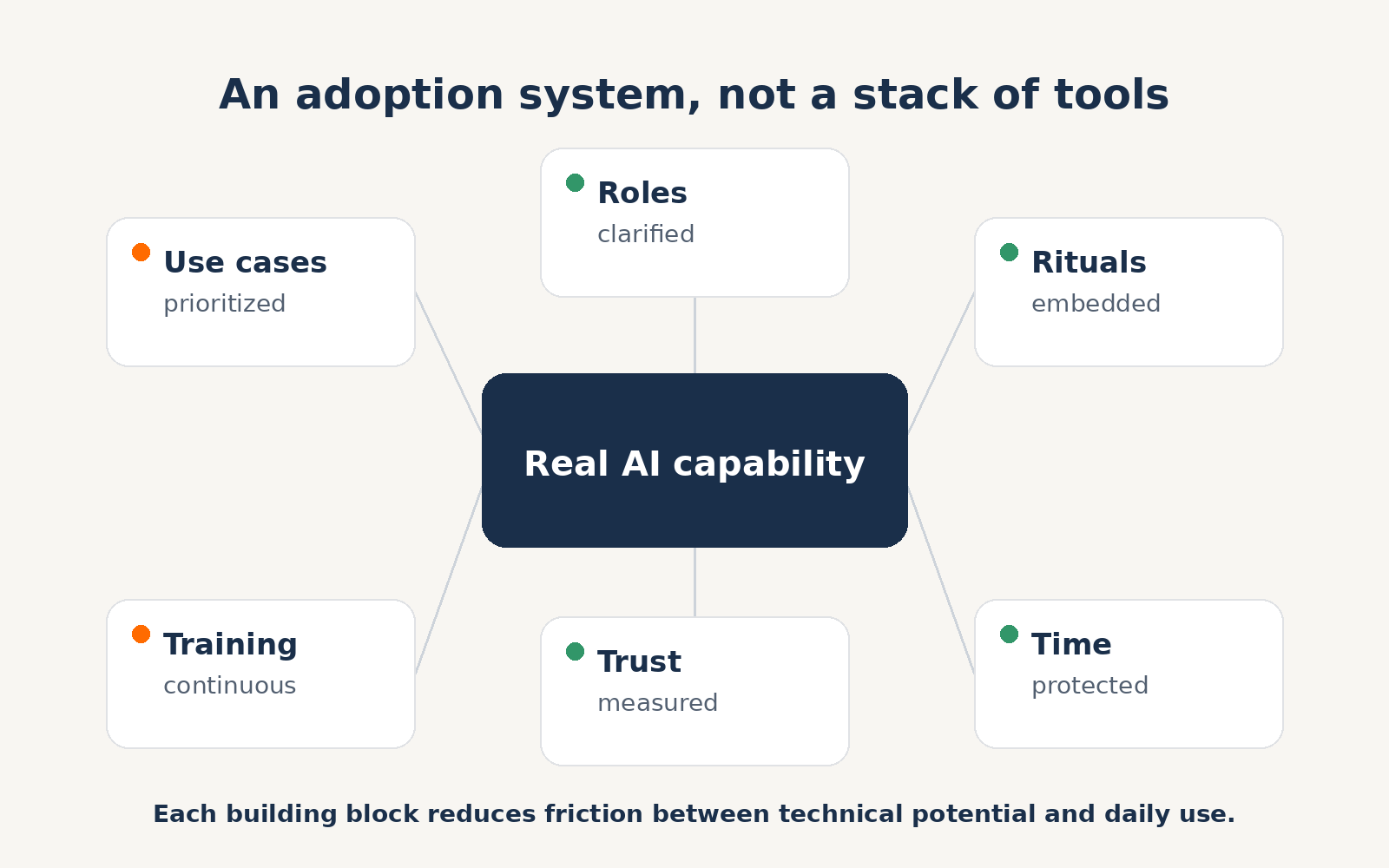
First, teams need use-case selection. Not every task deserves automation. The highest-leverage starting points are usually repetitive, information-heavy, or coordination-heavy workflows where review quality can be preserved.
Second, teams need role clarity. AI changes the boundary between doing, reviewing, approving, and escalating. If that boundary stays vague, people either over-trust the system or avoid it entirely.
Third, teams need rituals. A useful AI workflow is not a demo. It has to appear in planning, review, documentation, sales follow-up, support triage, product discovery, engineering routines, or management cadence.
Fourth, teams need training that is close to the work. Generic prompt training rarely survives contact with a specific pipeline, customer base, compliance constraint, or team habit.
Fifth, teams need trust mechanisms. That can mean examples, review gates, quality rubrics, audit trails, or explicit “do not automate this” rules.
Finally, teams need protected time. “Learn AI on top of your current workload” is not an adoption strategy. It is a recipe for uneven usage and quiet resistance.
The risk is not only “falling behind on AI.” It is more ordinary, and therefore more dangerous: a few people experiment on their own, others avoid the topic entirely, managers do not know what to allow, and workflows stay unchanged. After a few months, the company has paid for tools, but has not really changed how work gets done.
What B2B leaders should do with this reading
For founders and CEOs, the lesson is not to slow down. It is to stop treating adoption as a procurement problem. If AI is becoming important to business success, the operating model deserves as much attention as the vendor list.
For marketing and growth teams, the signal is especially concrete. Marketing AI Institute notes that marketers in the sample are increasingly expecting job disruption. That should not be reduced to panic. It should become a redesign question: which parts of research, campaign planning, content operations, reporting, and sales enablement can be augmented without destroying judgment, voice, and accountability?
For product, ops, and engineering leaders, the priority is workflow redesign. The question is not whether AI can produce artifacts. It can. The question is where AI output enters the system, who checks it, how it changes cycle time, and what new failure modes it creates.
For managers, the under-discussed work is emotional and practical. Teams need permission to experiment, but they also need boundaries. They need optimism, but not magical thinking. They need training, but also time to turn training into practice.
What remains uncertain
There are limits to this source pack.
The SmarterX report is survey-based. It tells us what respondents say they believe and experience. It does not directly measure the productivity gain of a given workflow, the quality of AI-assisted work, or the long-term labor-market outcome.
The B2B-specific angle is also partly mediated through Marketing AI Institute’s analysis. That is useful, but it should be treated as contextual framing rather than independent evidence.
So the conclusion should stay sober.
The report does not prove that tools no longer matter. Tools still matter a lot. Model quality, security, integration, cost, and governance all shape what is possible.
But the source does suggest that for many B2B teams, the next adoption frontier is less about adding one more AI product and more about building the conditions for people to use the products they already have.
That is a different kind of advantage.
Not a tool stack.
An adoption system.
If you lead a B2B team and AI is still stuck between individual experiments and real operational adoption, the best starting point is not necessarily another tool. It is often a simple audit of your workflows: where AI can help, where it should not decide alone, and which rules make its use reliable.
At GTL, this is the work we help clarify: turning scattered AI usage into concrete, understandable practices that the team can actually adopt.
Sources
- SmarterX — 2026 State of AI for Business Report
- Marketing AI Institute — This Is What B2B Marketers Need to Know About the Future of Work
- Marketing AI Institute — What B2B Professionals Really Think About AI in 2026