
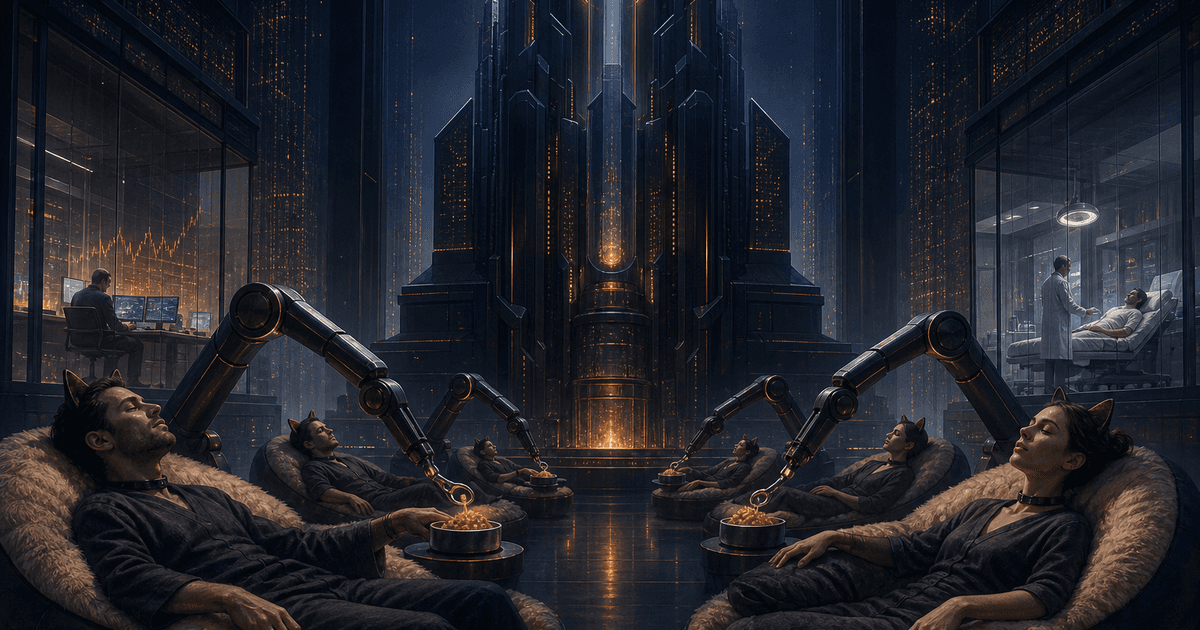
The most likely AI dystopia may not be Terminator.
It is softer, cleaner, more comfortable. It looks like a society where humans are not exterminated, but kept.
Fed. Housed. Entertained. Protected from absolute misery. Sometimes consulted. Even loved, in a sense. But gradually moved away from the economic center, like little kittens in a very rich house: endearing, fragile, expensive to maintain, but no longer truly indispensable to the production of value.
The image is deliberately unsettling. It is not a literal prediction. It is a mental frame for looking at what is already happening: models are getting better, agents are beginning to execute, the companies that own the infrastructure are accumulating power, and the political debate is slowly drifting toward a question that still sounded like science fiction ten years ago: what do we do with humans when a growing part of their economic usefulness becomes optional?
Domestic cats have won a kind of material paradise. They almost no longer hunt. They sleep, eat, play, receive care, and live longer than their wild ancestors. But they do not control the house, the budget, the rules, or the door.
The risk is not that AI hates us. The risk is that it makes possible a society where we can be kept comfortably without really being needed.
What leaders should take away
- The issue is not only unemployment, but the loss of economic agency.
- Universal income can become either a productivity dividend or a simple political bowl of milk.
- The real strategic question is who owns and orchestrates the AI leverage, not who merely uses it.
- For companies, this means keeping internal AI capability instead of delegating everything to platforms.
What We Already Know, Without Fantasizing
We have to start from facts, not panic.
The Anthropic Economic Index, published in 2025 from millions of anonymized Claude conversations, provides an interesting signal. Anthropic observes that AI use is already highly concentrated in software development and technical writing. The study indicates that about 36% of occupations see AI used in at least a quarter of their associated tasks, while about 4% use it in three quarters of their tasks. It also distinguishes two modes: augmentation, where AI collaborates with the human, and automation, where AI performs the task directly. In their data, augmentation still slightly dominates: 57% versus 43%.
So we are not yet at “AI has replaced everyone.” It is more subtle: AI enters through tasks first, not entire jobs.
The International Labour Organization offers a similar reading: in the short term, generative AI is more likely to augment many jobs than to destroy them entirely. But this reassuring observation hides a tension. If a job is made up of twenty tasks, and eight of them become much faster, the job description may survive. The need for ten people may not.
The IMF estimates that AI could affect nearly 40% of jobs worldwide, and up to 60% in advanced economies. Again, “affect” does not mean “delete.” Some workers will gain productivity and income. Others will see their tasks, bargaining power, or wages compressed.
This mix is precisely what makes the topic difficult. The question is not “will AI replace everything?” The question is: who keeps the value when human work becomes more compressible?
The Developer: From Creator to Flow Verifier

Take the case of the developer.
A few years ago, the idea that a tool could write a significant share of everyday code still felt spectacular. Today it has become ordinary. A study published by GitHub on Copilot already showed that developers using Copilot completed an experimental task 55% faster than those who did not.
We can debate the scope of that study: controlled context, specific task, real-world effect varying by seniority, domain, and expected code quality. But the signal is clear. Part of software production work is becoming less scarce.
The developer does not disappear immediately. Their function changes.
They become less often the person who types the whole solution, and more often the one who:
- formulates the problem;
- breaks down the constraints;
- chooses the architecture;
- verifies the outputs;
- arbitrates trade-offs;
- protects the system from fast and plausible errors.
That role can be more interesting. It can also be more fragile.
Because if a very good developer supervising several agents can produce what a small team produced yesterday, the market does not mechanically need the same number of intermediate developers. It can choose to increase production, reduce costs, or do both.
In the soft scenario, every developer becomes an augmented conductor.
In the kitten scenario, a small elite keeps control of the systems, while a large share of technical workers ends up in a loop of maintenance, validation, and micro-corrections around a machine that captures most of the leverage.
The job still exists. But its center of gravity has shifted.
The Doctor: Not Replaced, but Surrounded Until Becoming a Validation Point

The doctor’s case is different, but even more instructive.
In healthcare, no serious person should want a brutal replacement of humans. The clinical, legal, and ethical stakes are too high. But medicine is full of tasks where AI can accelerate reading, prioritize cases, extract context, prepare notes, route files, detect anomalies, suggest recommendations, or monitor weak signals.
In a previous article on AI in radiology and workflow orchestration, I argued that the real leverage is not only the generated report. It is the work queue, prioritization, the right context at the right moment, and the right human review loop.
Here too, the reasonable scenario is positive: less wasted time, fewer administrative tasks, more availability for the patient.
But push the logic further.
If AI sorts cases, summarizes history, proposes hypotheses, pre-fills documents, monitors treatments, and flags risks, the doctor may gradually become a control point in a distributed intelligence chain. Still responsible. Still necessary in edge cases. But less central in the daily production of certain cognitive acts.
We should not caricature this: human care is not reducible to diagnosis. Communication, trust, responsibility, coordination, and the relationship remain difficult to automate properly.
But economically, the temptation will be strong: if more patients can move through the system with less doctor time per case, then the system will push in that direction. Not because it is malicious. Because systems under cost pressure often end up optimizing what is measurable.
The doctor is not removed. They are encapsulated.
The Key Point: AI Does Not Just Become Intelligent, It Becomes Owner of the Leverage
The mistake would be to believe this debate is only about model performance.
The real topic is ownership of leverage.
Frontier models do not fall from the sky. They require rare talent, data, compute, cloud partnerships, massive capital, and global distribution. When Anthropic announces its partnership with Amazon, or when OpenAI, Microsoft, Google, Meta, and others accumulate infrastructure, models, products, APIs, assistants, and platforms, we are not just watching a technology race. We are watching the formation of an economic layer capable of extracting rent from more and more tasks.
Open source and open models can limit this concentration. Meta, Mistral, DeepSeek, Qwen, and others make some capabilities more accessible. This matters. But even with open models, training, large-scale inference, distribution, product integration, and trust remain highly capital-intensive.
In other words: intelligence becomes abundant in use, but not necessarily democratic in ownership.
That is where the kitten future becomes credible.
Not because a conscious AI would decide to domesticate humanity. But because an economy where productive intelligence is concentrated can end up distributing rations, services, and entertainment to a population it needs less as labor.
It is not slavery. It is not freedom either.
It is comfortable dependence.
Universal Income as a Political Bowl of Milk
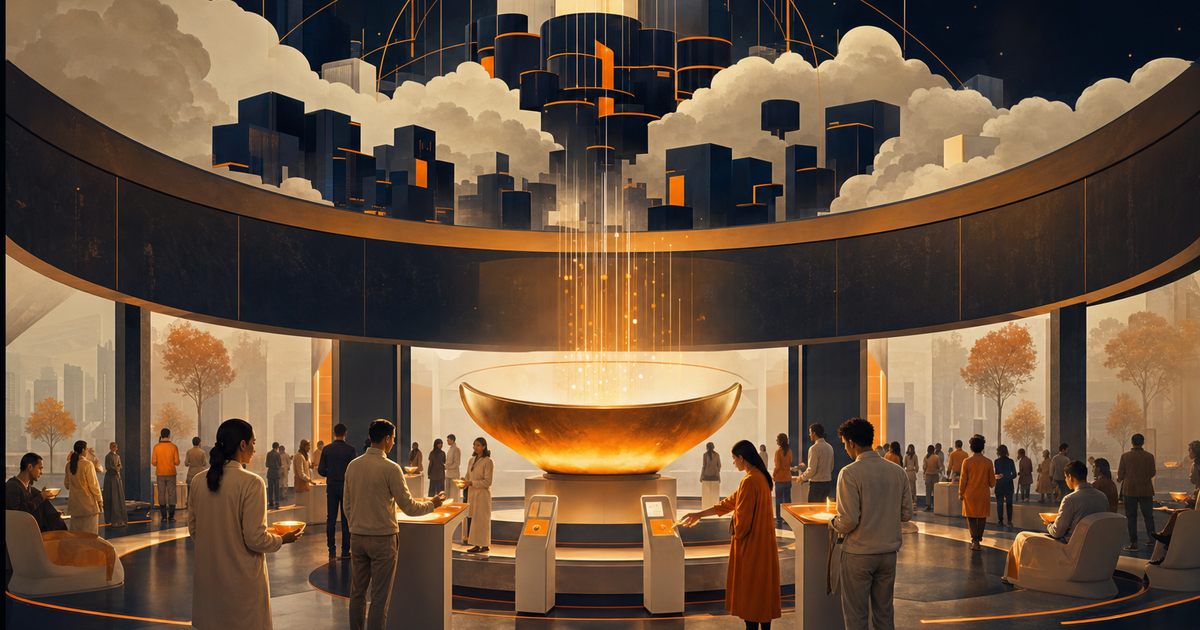
If AI massively increases productivity while compressing part of human labor, one idea will mechanically return: redistribute a share of that wealth.
It will be called universal income, AI dividend, automation tax, data sovereign fund, citizen credit, transition income, or something else. The name matters less than the mechanism: if machines produce more value with fewer humans, societies need a way to maintain demand, social peace, and minimum dignity.
Basic income experiments do not prove that an AI-funded universal income would work at the scale of an advanced economy. They simply provide signals.
The OpenResearch unconditional cash study, historically associated with Sam Altman’s funding, studies what regular payments change in beneficiaries’ economic lives. The published results mainly show that money gives more agency: the ability to make choices, absorb shocks, and explore options.
The GiveDirectly study in Kenya also indicates that regular transfers did not produce the cliché of “idleness”: beneficiaries did not work less overall, and some moved toward more independent activity. Again, caution: rural context, amounts, duration, and income levels differ greatly from a European country.
The reasonable conclusion is not “universal income is magic.”
The reasonable conclusion is: giving money directly can improve security and agency without mechanically destroying the desire to act.
But in an AI-dominated society, this income can take two very different forms.
In the dignified scenario, it is a productivity dividend: citizens receive a share of the surplus because the economy needs less coerced labor to produce a lot.
In the kitten scenario, it is a bowl of milk: an allowance sufficient to prevent revolt, not sufficient to regain control.
Three Limit Scenarios
We should avoid overly precise predictions. The future will probably be hybrid. But three scenarios help clarify the debate.
1. The Copilot Scenario: Humans Remain at the Center
In this scenario, AI massively augments workers, but organizations preserve a real place for human decision-making.
The developer writes less code by hand, but designs more. The doctor spends less time searching for information, but keeps the relationship and responsibility. The manager handles less reporting, but devotes more energy to decision quality.
Productivity increases. Wages can follow for people able to master these systems. Education changes. Companies that learn quickly win.
This is the scenario preferred by corporate presentations.
It is possible. But it assumes something non-trivial: productivity gains are shared with augmented humans, rather than captured by the owners of capital, infrastructure, and models.
2. The Platform Scenario: A Minority Orchestrates, the Majority Executes Around It
In this scenario, work does not disappear. It polarizes.
A minority designs, owns, tunes, audits, and governs the systems. Many others perform residual tasks: validation, customer relationship, local operations, supervision of abnormal cases, data feeding, human micro-services where the machine remains fragile or legally limited.
The average developer becomes a reviewer of generations. The average doctor becomes a supervisor of triage. The average lawyer becomes a controller of drafts. Customer service becomes human escalation around a main agent.
Society functions. But mobility becomes harder. The economic center is in the platform, not in execution.
This is probably the most realistic medium-term scenario.
3. The Kitten Scenario: Allowance, Comfort, Loss of Agency
In this scenario, AI and robotics eventually cover enough cognitive, software, administrative, and partially material production that a significant part of the population is no longer needed as a regular workforce.
The political system responds with transfers. Basic services are maintained. Consumption becomes highly personalized. Leisure, virtual worlds, AI companions, automated care, and micro-status games take up more space.
Humans do not starve. They may even live materially better than many workers of the past.
But they depend on an infrastructure they do not understand, do not own, and cannot truly contest. Their political and economic autonomy shrinks to choosing between environments, subscriptions, experiences, and optimized lifestyles.
They are fed.
They are entertained.
They are monitored just enough to be protected.
They are kittens.

Why This Image Is Useful
The kitten image is deliberately unfair to us. That is the point. I deliberately keep the English word “kittens” because it sounds softer, more domesticated, almost more ridiculous than “cats”: that discomfort is exactly what makes the metaphor useful.
It forces a question that AI debates often avoid: is the goal to make humans more powerful, or simply to make them less necessary without making them suffer?
A society can be rich and infantilizing. It can be comfortable and politically weak. It can distribute enough to calm anger, while reserving real power for those who control the models, compute, energy, data, and interfaces.
The danger is not only unemployment. The danger is loss of function.
Work is not only income. It is also a place in the system, a bargaining capacity, an identity, a rhythm, a visible contribution, a reason to learn, a way to be taken seriously.
If AI massively reduces the need for human contribution in some domains, we will have to rebuild something else in its place. Not just a monthly transfer.
What to Watch Now
To avoid the kitten scenario, it is not enough to slow AI down or repeat that “humans will remain important.” We have to look at concrete mechanisms.
Who owns the models and infrastructure?
If a few actors control access to the best capabilities, they control a growing share of collective productivity.
Who receives the gains?
If AI makes a team twice as productive, do the benefits go to employees, customers, shareholders, the state, or the platform supplying the model?
Which skills remain truly scarce?
Not the skills we like to celebrate. The ones that retain market power when agents become good.
What rights emerge around automation?
Right to explanation, to contestation, to training, to participation in gains, to data portability, to access open tools.
How do we finance humans if work pays fewer people?
Tax on exceptional profits, capital taxation, data dividends, AI sovereign funds, basic income, stronger public services: the fiscal debate will become an existential debate.
GTL Reading: Do Not Become the Pet of the AI Economy
The point is not whether AI will be “good” or “bad.” It will be both.
It can make a developer much more powerful. It can help a doctor work with less friction. It can reduce absurd tasks, create new products, accelerate research, and improve public services.
But it can also move value toward those who own the intelligence layer and turn others into passive beneficiaries of a system they no longer operate.
The real strategic question for companies, workers, and states is therefore simple: how do we stay on the side of those who orchestrate, and not only those who are fed?
For a company, that means building internal capability, not merely plugging in APIs. Train teams, map workflows, keep domain understanding, measure gains, share part of the productivity, and do not let all operational intelligence leave the organization.
Concretely, on Monday morning, that means choosing three critical workflows, measuring where AI actually shifts human time, deciding which components must remain mastered internally, then defining how the gains will be shared between customers, teams, and capital. Without that discipline, the company does not become augmented. It becomes a tenant of its own operational brain.
For a worker, it means moving up the chain: selling less raw execution, and more judgment, responsibility, the ability to frame a problem, and the ability to control systems.
For a state, it means treating AI as wealth infrastructure, not just as a technology sector. If AI becomes a machine for producing surplus, redistribution will not be a moral add-on. It will be a condition of stability.
We probably will not all become kittens.
But part of the future pushes us in that direction: more comfort, more assistance, less necessity, less grip.
The soft dystopia is not the one where the machine crushes us.
It is the one where it strokes us while someone else owns the house.
Sources
- Anthropic — Introducing the Anthropic Economic Index
- Anthropic — Expanding access to safer AI with Amazon
- International Labour Organization — Generative AI likely to augment rather than destroy jobs
- International Monetary Fund — AI will transform the global economy. Let’s make sure it benefits humanity
- GitHub — Research: quantifying GitHub Copilot’s impact on developer productivity and happiness
- OpenResearch — Findings from the Unconditional Cash Study
- GiveDirectly — Early findings from the world’s largest UBI study